1. Why the project exists
Red Half Lab was started by a Liverpool supporter to help fellow fans and the wider Liverpool community understand the team and its players through data. The project brings that work into one place, where reports can be read alongside the football and discussed as the models develop.
A judgement about a player often contains several different questions. Contribution to the passing structure, chance creation and regaining possession describe different parts of a performance. A report becomes more useful when it makes clear which part is being assessed and what the model can support.
That is the motivation behind Red Half Lab: to develop a more informed basis for those discussions. The project aims to explain the reasoning behind a report, make its limits visible and keep a record of how the work changes. Its value will depend on whether supporters find those explanations useful for understanding Liverpool.
The website is the collection point for the projects. The modelling, evaluation and development continue behind it; the public pages bring together model results, reports and research progress. Red Half Lab is independent of Liverpool Football Club.
2. What the project aims to do
The central goal is to build reports about Liverpool’s team and players that become more informative as the evidence and models develop. A reader should be able to identify the football question, understand the result and recognise where a conclusion remains uncertain.
REDS addresses the next Premier League match and a separate set of wider fan questions. A match report might examine the likely score or a player’s contribution if that player appears. A fan question can compare roles, players or periods. Those uses need different targets and explanations.
Match Pulse is a separate research project about form, cards and match style. Its public tracker currently contains aggregate progress. Its individual match forecasts remain private.
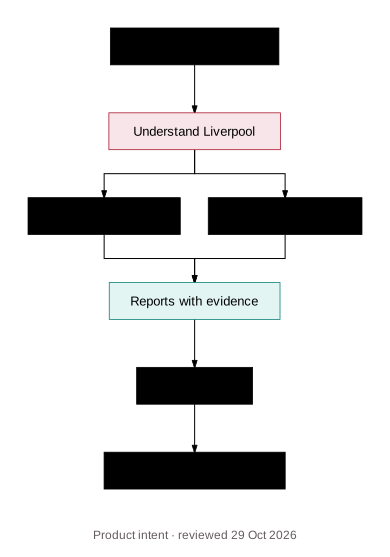
The diagram connects those projects to their intended audience. The reports are meant to help supporters follow a specific question through to an explanation, then bring observations and follow-up questions back to the project.
The purpose of the project
3. The team and player data
The current REDS match system has 15 tasks: 2 for the team, 10 for player contributions and 3 for goalkeepers. Its report directory also provides match context, including recent form, head-to-head results and upcoming fixtures.
| Area | What the reports cover |
|---|---|
| Liverpool team | Score and result, clean-sheet outlook, match dominance, recent form and fixtures. |
| Players | Starting, attacking contribution, passing share, progression versus losses, regaining possession, aerial contests, crossing, player-of-the-match assessment, box protection and opposition-box involvement. |
| Goalkeepers | Shot threat faced, goals prevented and interventions around the box. |
The team score model supports several related views, including the score, result and clean-sheet outlook. Those views come from the same score distribution; they are not separate models merely because they appear as different questions.
Player coverage includes Alisson, Virgil van Dijk, Jeremie Frimpong, Florian Wirtz, Dominik Szoboszlai, Ryan Gravenberch, Cody Gakpo, Alexander Isak. The saved directory has 32 profiles, covering established players, newer arrivals and younger players in the project record.
Player profiles in the current directory
Joe Gomez, Virgil van Dijk, Jeremy Jacquet, Milos Kerkez, Conor Bradley, Giovanni Leoni, Kostas Tsimikas, Jeremie Frimpong, Ronald Araujo, Calvin Ramsay, Ifeanyi Ndukwe, Alexander Isak, Federico Chiesa, Cody Gakpo, Hugo Ekitike, Victor Munoz, Bradley Barcola, Rio Ngumoha, Alisson Becker, Giorgi Mamardashvili, Freddie Woodman, Armin Pecsi, Vitezslav Jaros, Harvey Davies, Wataru Endo, Florian Wirtz, Dominik Szoboszlai, Alexis Mac Allister, Harvey Elliott, Ryan Gravenberch, Trey Nyoni, James McConnell.
The fan notebook contains 32 questions. Examples include Van Dijk's duels across different periods, Wirtz and Szoboszlai in the number-ten role, and Frimpong at right-back and in a right-sided attacking role. These comparisons give the project a way to investigate specific football questions beyond a single match.
Coverage varies. A profile does not mean every task has a supported answer for that player, and some saved questions use older evidence. Appearance conditions, positional references and evidence dates remain part of the individual report. The player directory provides those details.
4. Progress and baseline checks
REDS has progressed from model development to a working interface for selecting questions, reading match and player reports, and following post-match checks. The content service supplies the selected answer and its chart instructions; the website presents that report.
The current system contains 15 match tasks. Of these, 14 have passed the current label-quality checks on the outcomes used to train and evaluate them. Attacking contribution remains experimental because those checks are unresolved for that task. The task count therefore describes the system's scope, not fifteen equally established findings.
A simple baseline provides a reference for judging whether the model adds anything. The two examples below come from the stored historical forward checks: the score-and-result task was checked across 444 matches, and the starting task across 555 player appearances. In the latter, the question is whether a player starts given that the player appears.
Model and baseline in two historical checks
Log loss measures the quality of the probabilities assigned to outcomes. Lower is better.
Score and result
444 matches
Starting, given an appearance
555 player appearances
Both stored model scores are lower than their baselines. The score-and-result advantage is modest, while the starting comparison shows a larger difference on its own task. These results support continued development; they do not establish a live success rate or guarantee the next forecast.
New evidence also has to be checked before a model changes. A candidate that fails the replacement criteria leaves the current model in place. Missing post-match evidence remains pending, and later improvements belong in future forecasts without rewriting earlier records.
The next stage is to build a longer record of genuine pre-match forecasts and later checks, and to improve reports where the available evidence is incomplete. The full baseline report and development log keep those comparisons and changes accessible.
5. Community and resources
X carries project updates, while Discord provides a place for discussion and suggestions. A useful community question may identify a missing comparison, challenge a definition or point to something in the football that a report has not explained.
Public work is available through GitHub. The Match Pulse repository contains dated research summaries; it is not a release of the private models. The roadmap sets out planned work, and the development log records completed changes.
Evidence and revision history
Sources and scope
- REDS report directory
Team and player coverage checked on 29 October 2026.
- REDS historical baseline report
Saved forward-check summaries for the match models. Historical scores are separate from genuine live results.
- Development log
Dated implementation progress and its limits.
Corrections and revisions
- · Initial version, setting out the project's purpose and current limits.
- · Local editorial revision: clarified the evidence, personal voice and current disclosure scope.
- · Rewrote the introduction around the creator's purpose: helping Liverpool supporters understand the team and its players, with the website as a home for the developing reports.
- · Clarified the purpose for supporters and connected the introduction to the existing REDS match models and fan questions.
- · Changed the narration to third person while retaining the creator's purpose and the evidence scope.
- · Reorganised into the five requested sections. Other columns were removed; coverage and baseline examples use a dated public-field snapshot.
Corrections can be sent to contact@redhalflab.com with the page, passage and supporting evidence. Contact and feedback