REDS post-match check · Liverpool 4–0 Manchester United, 22 November 2026 · Pre-match forecast saved 22 November 2026 (11:03 GMT) · Check updated 27 November 2026 (11:49 GMT) · Article checked 28 November 2026
Overview
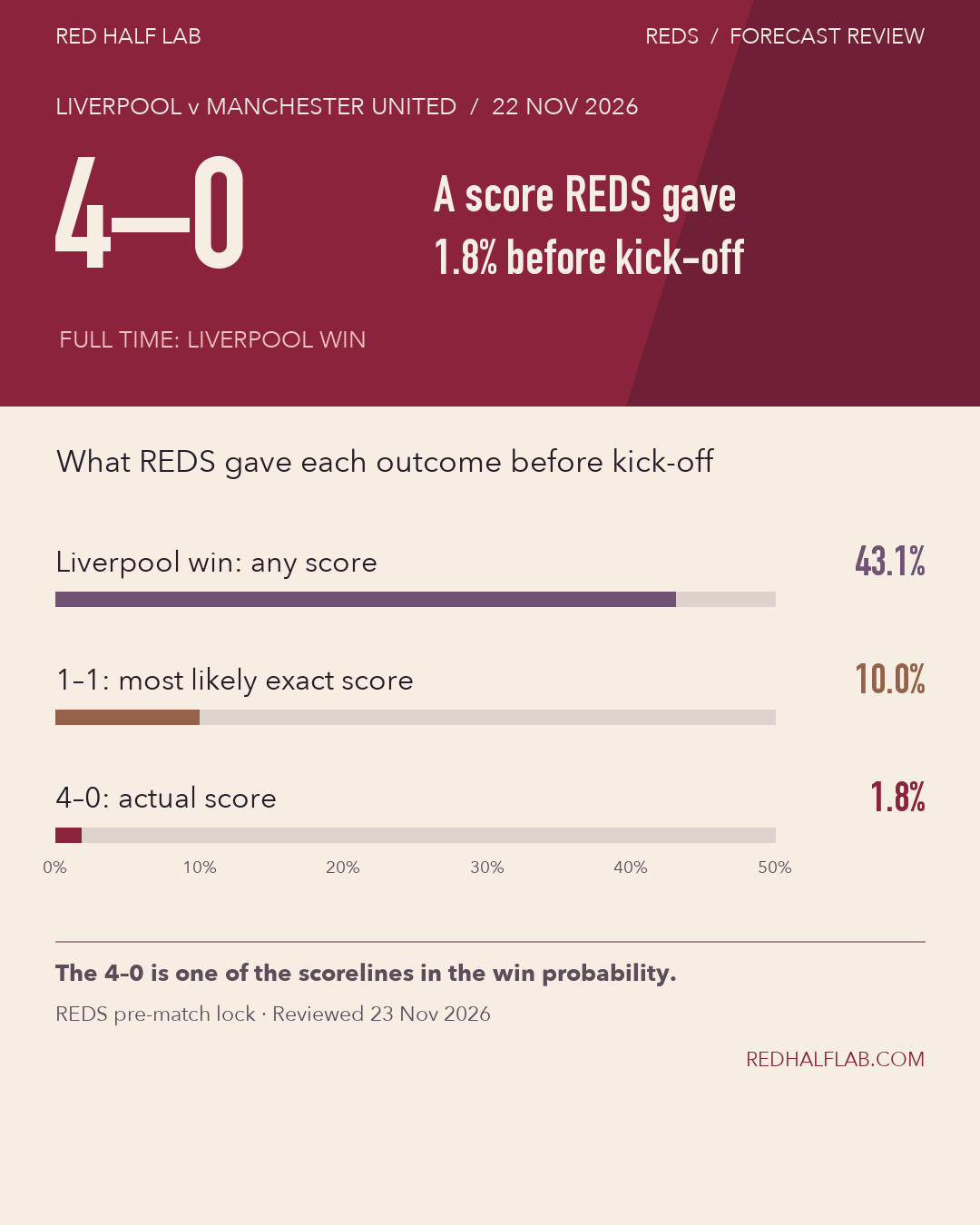
Liverpool beat Manchester United 4–0 at Anfield on 22 November 2026 after Leny Yoro was sent off in the eighth minute. Dominik Szoboszlai (10’), Florian Wirtz (13’), Rio Ngumoha (66’) and Víctor Muñoz (82’) scored the goals. Before kick-off, REDS made Liverpool 43.1% favourites to win by any score, picked a 1–1 draw (10.0%) as the single most likely exact score, and assigned 4–0 a 1.8% probability.
In the post-match check updated on 27 November 2026, 60 of REDS’ 210 saved pre-match records across 15 prediction types have been checked against post-match data. Both team first picks—exact score (1–1) and match balance (Mixed game)—missed. Across the player records that were scored, REDS hit five of six progression-versus-loss categories and beat the player’s own past record on 21 of 44 numeric and ratio checks, while past form was closer on 12 (including both checked goalkeeper targets) and 11 showed no clear advantage.
This column follows directly from Red Half Lab’s pre-match Liverpool v Manchester United preview, which walked through the saved score grid, match-balance forecast and player roles before kick-off. Comparing that pre-match record with the public post-match check shows how probabilistic forecasts behave when an early red card pushes a fixture into the outer edge of the pre-match distribution, without changing any saved forecast after full time or exposing private technical match actuals.
A 4–0 win inside a 43.1% win forecast
The pre-match forecast checked here was saved locally at 11:03 GMT on 22 November 2026—roughly five and a half hours before the 16:30 GMT kick-off (local pre-match record, receipt 2a92652be50a; not a confirmed cloud lock). Its headline numbers matched the earlier 13 November preview snapshot: a Liverpool win at 43.1%, a draw at 23.5% and a Manchester United win at 33.4%, with expected goals of 1.56 for Liverpool and 1.32 for United.
Those two facts—Liverpool were the favoured winner at 43.1%, and the exact-score check recorded a miss—sit together without contradiction. REDS builds match results, goal totals and clean-sheet odds from the same score grid. Inside that grid, 1–1 carried the highest single-cell probability at 10.0%, just ahead of 2–1 (9.5%), 2–0 (8.0%) and 1–0 (7.3%). Because 1–1 was the top single scoreline, the public check scores the exact-score call as a miss against 4–0. At the same time, 4–0 sat inside the 43.1% Liverpool win total at 1.8% (1.78% unrounded); those percentages are not added together.
Looking at the wider goal distribution explains why a four-goal win sat so far in the tail. Before kick-off, REDS gave Liverpool an 8% chance of scoring four or more goals and a 30% chance of keeping a clean sheet. Grouping the 18 November public score grid by winning margin put 59.2% of outcomes on a draw or a one-goal margin and 39.4% on a gap of two goals or more, with 1.4% unclear because scores of four or more goals per side are grouped together in the public table. The pre-match balance of evidence pointed to a tight match.
What happened on the pitch explains the gap between that tight pre-match picture and the final score without excusing the miss. Yoro’s red card in the eighth minute reduced Manchester United to ten men almost immediately. Szoboszlai scored two minutes later, Wirtz added a second from Ngumoha’s pass in the 13th minute, and Liverpool added two more after the hour through Ngumoha (66’) and substitute Víctor Muñoz (82’). A pre-match model can only use information available before kick-off; it cannot anticipate an eighth-minute sending-off, and once that event arrived, the fixture moved straight into the low-probability tail of the pre-match score grid.
The same separation shows up in Match Balance, which REDS models independently of the scoreline. Before kick-off, REDS gave Mixed game 60.9% (61% rounded in the preview chart), compared with 24.2% for Liverpool on top and 14.9% for Manchester United on top. In REDS, a side finishes on top only by leading on expected goals, big chances and shots on target at the same time. The public post-match check records the Mixed first pick as a miss, while keeping the underlying technical match statistics private.
Why 60 of 210 saved records are checked—and why the rest stay open
A common mistake when reading a post-match audit is to treat 60 of 210 as an accuracy score. It is not. On the 27 November check (updated at 11:49 GMT), 60 is the number of pre-match records that have completed a verified comparison against post-match data across the 15 prediction types. The remaining 150 records fall into four distinct non-scored states: 130 where participation is unconfirmed or the player did not appear, 11 awaiting post-match data, 6 marked not applicable and 3 with no saved pre-match forecast.
Most of the 210 records are conditional player forecasts covering 19 outfield players across nine targets, 28 squad players for conditional starting probability and three goalkeepers across three targets. Because every player forecast assumes the player actually takes the pitch, absences remove whole blocks of records from scoring. Two players highlighted in pre-match coverage—Hugo Ekitike, who topped the 17 November scoring-chance forecast at 31% and the progression-risk list at 32.0%, and Cody Gakpo (22% scoring chance, 13.3% box-touch share)—did not appear against Manchester United. Neither did Federico Chiesa, Conor Bradley, Ryan Gravenberch, Wataru Endo, Kostas Tsimikas, James McConnell, Giorgi Mamardashvili or Freddie Woodman.
Coverage is also incomplete because post-match verification arrives in stages. Eight appearing players from the 19-player outfield set have been confirmed so far: Virgil van Dijk (90’), Dominik Szoboszlai (90’), Florian Wirtz (90’), Alexander Isak (85’), Rio Ngumoha (78’), Alexis Mac Allister (72’), Jeremie Frimpong (12’) and Joe Gomez (5’). All eight are still awaiting data for Player of the match (eight records pending), while Frimpong and Gomez remain awaiting data for Progression vs losing possession and Alisson Becker remains awaiting data for Box claims.
Other Liverpool players who took part on 22 November—starters Jérémy Jacquet, Bradley Barcola, Ronald Araujo and Milos Kerkez, plus substitutes Trey Nyoni, Víctor Muñoz and Lewis Koumas—still sit under appearance unconfirmed or outside the 19-player outfield check set in the 27 November snapshot. Meanwhile, all 25 forecast rows for Chance of starting remain unconfirmed alongside three players with no pre-match forecast, and six further rows are marked not applicable because the required action condition was not met (five outfielders in Cross completion and Frimpong in Aerial balance).
Keeping those categories separate protects the integrity of the audit. Awaiting data is not a miss, an unconfirmed appearance is not converted into a zero, and a conditional forecast for an unused player is never scored after kick-off.
Outfield player roles: where REDS beat past form and where it trailed
Because REDS does not publish private technical match actuals or exact numerical differences, the public post-match check evaluates numeric and ratio player forecasts by a concrete yardstick: was REDS’ pre-match forecast closer to what happened than simply expecting the player’s own past record from earlier matches? Where both approaches land too close to separate cleanly, the check records no clear advantage.
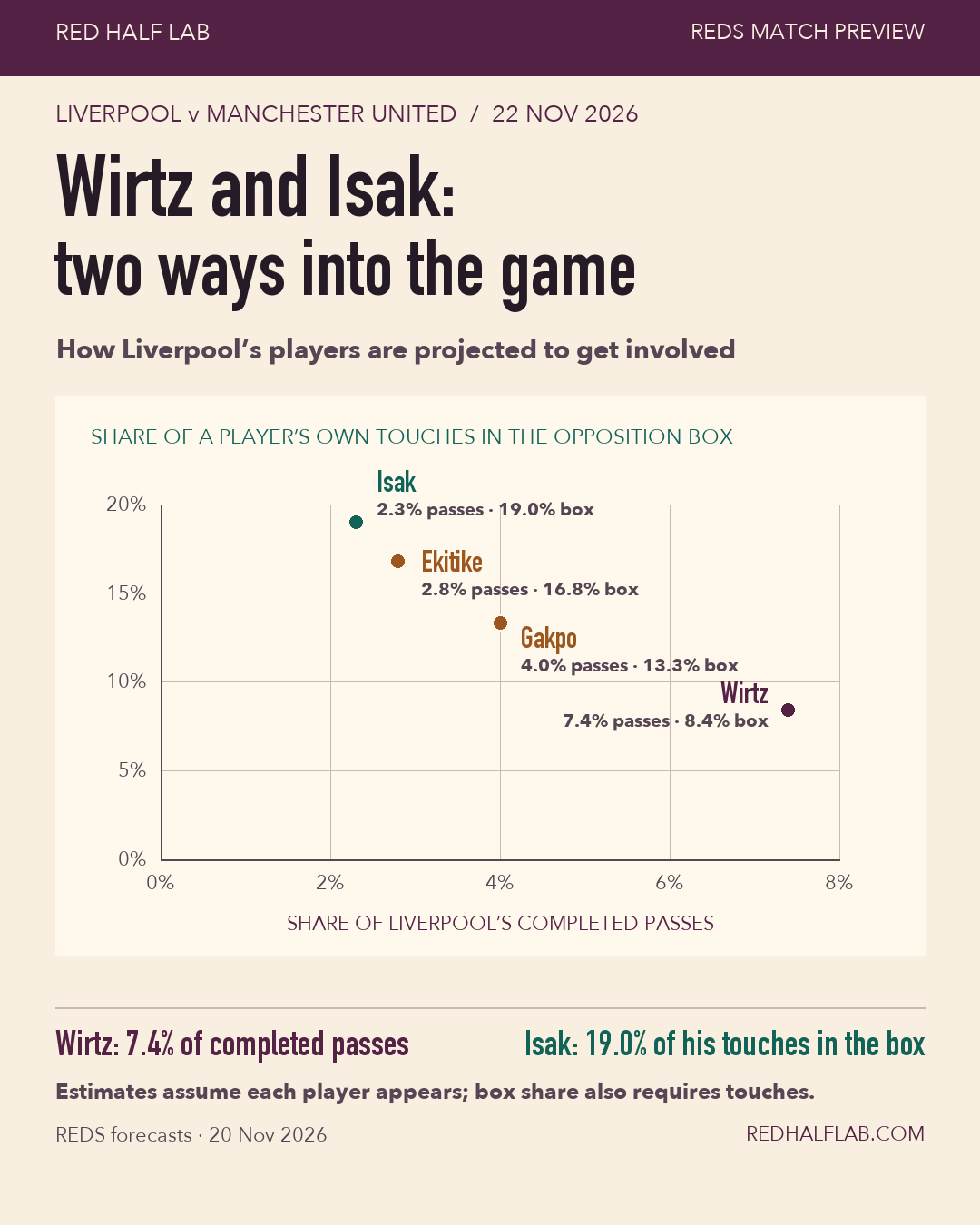
The 20 November passing-and-box-touches chart gives a clear window into how that check works across both missing and appearing players. Pre-match, REDS contrasted Florian Wirtz (7.4% share of completed team passes, 8.4% of his own touches in the opposition box) with Alexander Isak (2.3% pass share, 19.0% box-touch share), alongside Ekitike (2.8% and 16.8%) and Gakpo (4.0% and 13.3%). Ekitike and Gakpo did not play, leaving only Wirtz and Isak to be checked. For Isak (85 minutes), REDS was closer than his past record on both pass share and opposition-box touch share. For Wirtz (90 minutes), REDS was closer on box-touch share, while his own past record was closer on pass share.
Across all eight checked outfield players, that pattern—stronger than past form on several ball-usage and involvement targets, mixed on others—repeats clearly. In Pass share, REDS was closer than past form for five players (Van Dijk at 13.1%, Szoboszlai at 9.6%, Isak at 2.3%, Frimpong at 3.6% against his 3.8% 25-match average, and Gomez at 5.4%), past form was closer for two (Wirtz at 7.4% and Ngumoha at 1.7%), and Mac Allister (8.8%) showed no clear advantage. In Touches in the opposition box, REDS again won five of eight comparisons (Isak, Wirtz, Frimpong at 6.5% against his 8.6% 35-match average, Szoboszlai at 2.4% and Van Dijk at 2.1%), while past form was closer for three (Mac Allister, Ngumoha and Gomez).
Ball regains and Cross completion were the cleanest areas for REDS in this fixture. On Ball regains (tackles won, interceptions and recoveries combined), REDS was closer than past form for five of the eight checked outfielders—Szoboszlai (6.56 expected), Wirtz (5.71), Isak (1.95), Gomez (4.38) and Ngumoha (1.40)—with zero going to past form and three showing no clear advantage (Mac Allister, Van Dijk and Frimpong). On Cross completion, only three players met the eligibility condition, and REDS was closer than past form for all three: Szoboszlai (30.4%), Wirtz (22.6%) and Ngumoha (19.7%, below his 31.0% rate across 15 earlier matches).
In Progression vs losing possession—the category highlighted in the pre-match preview—REDS’ top pick hit on five of six checked appearances. Van Dijk (97.8%), Szoboszlai (96.5%), Mac Allister (95.1%), Wirtz (79.2%) and Ngumoha (64.1%) were all backed to progress the ball more often than they lost it, and all five matched. The lone miss was Isak (85’), whom REDS backed at 67.3% to progress more than lose while flagging a 19.8% turnover-risk probability—fourth highest in the pre-match risk list. Even in missing Isak’s first pick, REDS left more room for what happened than his own past record did; across the five hits, however, past form was closer for four players, with Szoboszlai (96.5% versus 92.0% across 87 earlier matches) the one hit where REDS edged past form.
The clearest misses among outfield players came in Attacking contribution, which divides a match into six ordered levels—from No shot or key pass up to Goal—and carries an explicit caution on the public page because some older big-chance records still need verification. In a 4–0 win where Szoboszlai, Wirtz and Ngumoha all scored, single-category top picks missed seven of eight times: only Jeremie Frimpong (12 minutes off the bench, backed for No shot or key pass at 38.9% against a 15.4% 13-match past frequency) hit his first choice. Judging the full probability distribution rather than the top label alone shows a split rather than a collapse: REDS was closer than past form for three players—Frimpong, Szoboszlai (12.4% to score against an 8.3% 60-match past rate) and Wirtz (14.8% to score against a 6.7% 15-match past rate)—while past form was closer for five (Mac Allister, Isak, Gomez, Ngumoha and Van Dijk).
Defensive and aerial checks were quieter for REDS. On Aerial balance, past form edged REDS four to three: it was closer for Van Dijk (+1.56), Mac Allister (-0.05), Gomez (+0.01 against a +1.00 median over 158 matches) and Ngumoha (-0.47), while REDS was closer for Szoboszlai (-0.40 against a -1.00 median over 82 matches), Wirtz (-0.60) and Isak (-0.75). On Box defending (clearances, blocks and goal-line clearances), seven of eight players showed no clear advantage, and Van Dijk’s 6.02 estimate trailed his own past record.
The goalkeeper check: where past form beat the pre-match forecast
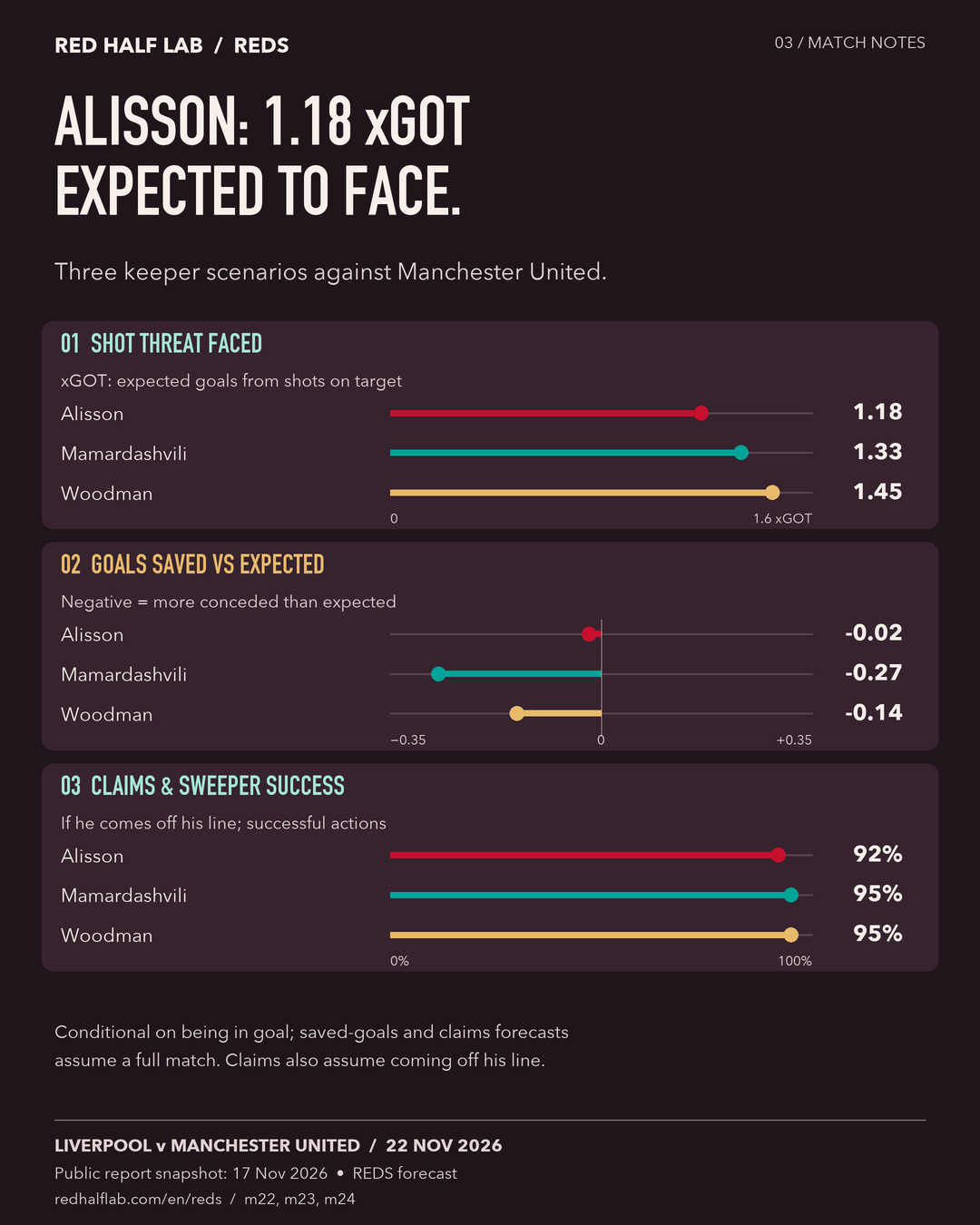
Before kick-off, REDS mapped three conditional goalkeeper scenarios for Alisson Becker, Giorgi Mamardashvili and Freddie Woodman across three separate scales: expected shot threat faced (xGOT), goals saved versus expected, and successful high claims or sweeper actions. For Alisson, the saved pre-match forecast stood at 1.18 xGOT faced, -0.02 goals prevented and 91.7% (rounded to 92% on the 17 November chart) box-claim success.
Alisson started and played all 90 minutes in the 4–0 win; Mamardashvili and Woodman did not appear, so their conditional scenarios remain unscored. On both goalkeeper targets that have completed checks—shot threat faced and goals prevented—Alisson’s own past record was closer to the match outcome than REDS’ pre-match forecast. On goals prevented, REDS had set him slightly below zero (-0.02) compared with his historical median of +0.13 across 166 earlier appearances from September 2020 to October 2026, and sticking with his usual level proved closer this time. His third target, Box claims, remains awaiting data.
A clean sheet against a ten-man opponent naturally alters a goalkeeper’s workload compared with an eleven-versus-eleven pre-match baseline, especially when pre-match drivers leaned on opposition context to project 1.18 xGOT faced. Still, the post-match check records both outcomes plainly as past-form wins rather than filtering them out.
What one match can and cannot prove
Put together, the 60 checked records from Liverpool 4–0 Manchester United give a balanced snapshot rather than a simple pass or fail. Across the 44 numeric, ratio and continuous comparisons (42 outfield and 2 goalkeeper), REDS finished closer to the match outcome than each player’s own past record 21 times, past form was closer 12 times, and 11 comparisons showed no clear advantage. Across the 16 categorical first-pick checks, REDS hit 6 times (five in Progression vs losing possession and one in Attacking contribution) and missed 10 times (exact score, match balance, one progression check and seven attacking-level picks).
No single match—least of all one reshaped by an eighth-minute red card—can establish whether a model is reliable over a season. That is why the public post-match page keeps two comparisons strictly separate: this match’s personal past-record checks (computed after full time using only each player’s earlier matches, against forecasts saved before kick-off) and whole-model historical forward tests across hundreds of earlier matches using only pre-match information.
On the historical forward-test tab, five of the 15 prediction types currently carry verified out-of-sample comparisons against population past baselines (lower scores mean better performance): Score & result records a log loss of 3.270 for REDS against 3.316 for the baseline across 444 matches (2015–October 2026); Attacking contribution records 1.513 against 1.657 across 2,677 player records (2018–September 2026, flagged for extra caution); Player of the match records 0.275 against 0.286 across 1,506 records (2019–August 2026); Goals prevented records a mean absolute error of 0.58 goal equivalents against 0.59 across 83 goalkeeper records (2024–October 2026); and Box claims records 12.17 percentage points against 12.73 across 237 records (2018–September 2026). For the remaining ten prediction types—including Match Balance, Pass share, Progression vs losing possession, Ball regains and Box-touch share—historical test comparisons are explicitly marked unavailable until enough verified records exist.
Reading the pre-match preview alongside this post-match check shows what evidence-based tracking is meant to do: save the probabilities before kick-off, keep misses on the page when a match takes an unexpected turn, distinguish missing data from wrong calls, and wait for larger verified samples before drawing broad conclusions. Readers inspecting the live post-match check page should select 22 November 2026 · Manchester United in the match menu once later Premier League fixtures are added, and can revisit the project introduction for the wider scope of Red Half Lab.
Read the pre-match preview: Liverpool v Manchester United (22 November 2026)
Open the REDS post-match check (select 22 November · Manchester United as later fixtures arrive)
View the official Liverpool FC match record (Liverpool 4–0 Manchester United)
Read the Red Half Lab project introduction
Evidence and revision history
Sources and scope
- REDS post-match check for Liverpool 4–0 Manchester United
Pre-match forecast saved locally on 22 November 2026 at 11:03 GMT (receipt 2a92652be50a; not a confirmed cloud lock) and checked on 27 November 2026 at 11:49 GMT. Select 22 November 2026 · Manchester United in the fixture selector once newer matches are added.
- Liverpool v Manchester United pre-match preview (16 November 2026)
Published pre-match column preserving the 13 November 2026 REDS match-centre and player-roles snapshots.
- Official Liverpool FC match record: Liverpool 4–0 Manchester United
Conventional public match facts: full-time score (4–0), eighth-minute red card, goalscorers, assists and line-ups.
Corrections and revisions
- · Pre-match forecast saved 22 November 2026 (11:03 GMT); public post-match check updated 27 November 2026 (11:49 GMT); article checked 28 November 2026.
Corrections can be sent to contact@redhalflab.com with the page, passage and supporting evidence. Contact and feedback